Turn Content You Already Wrote Into Daily Posts While You Sleep
Published: July 25, 2026 | 9 min read
There are two types of Prisca.
Most people in my life only ever meet the first one. The quiet, smart, shy Prisca who picks the corner seat and lets everyone else do the talking.
But there is another version of me that has lived in my head for as long as I can remember. She is dramatic, a little chaotic, and allergic to doing things the normal, boring way.
For most of my life, I honestly did not think I would ever have to let her out. Then I started working with AI.
And that other Prisca, the one in my head, was not content to use AI the way most technical people use it. Type a prompt, copy the answer, close the tab, repeat. Yawn. That was never going to be enough for her.
So I built a team of AI agents. And because I am extra, I gave every single one of them a name and a personality.
Today I want to tell you about one of them. His name is Igor Jarvis, and he joined my team last year, back in December 2025.
As you meet him, I want you to keep half an eye on your own work, because the honest truth is that this post is not really about Igor. It is about a pattern you can borrow, and it ends somewhere you probably will not expect, because I do not actually use Igor anymore.
More on that at the end...
A Week in the Life of Autonomous Igor
Picture this. It is Monday morning and my alarm just went off at 5:30 AM. I am still half asleep, reaching for my phone to silence it, when I see a Telegram notification from Igor.
He woke up at 5 AM. I was still unconscious.
While I slept, he did the exact job I built him for. He reads through everything I have ever published, the 170+ long blog posts sitting on my site, and mines them into short, postable pieces, so the value buried in long form writing nobody has time to finish actually reaches people. He does the repurposing I could never make myself do.
Here are two of his 5 AM messages:
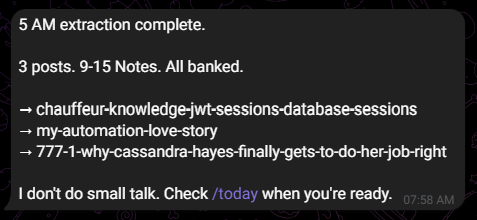
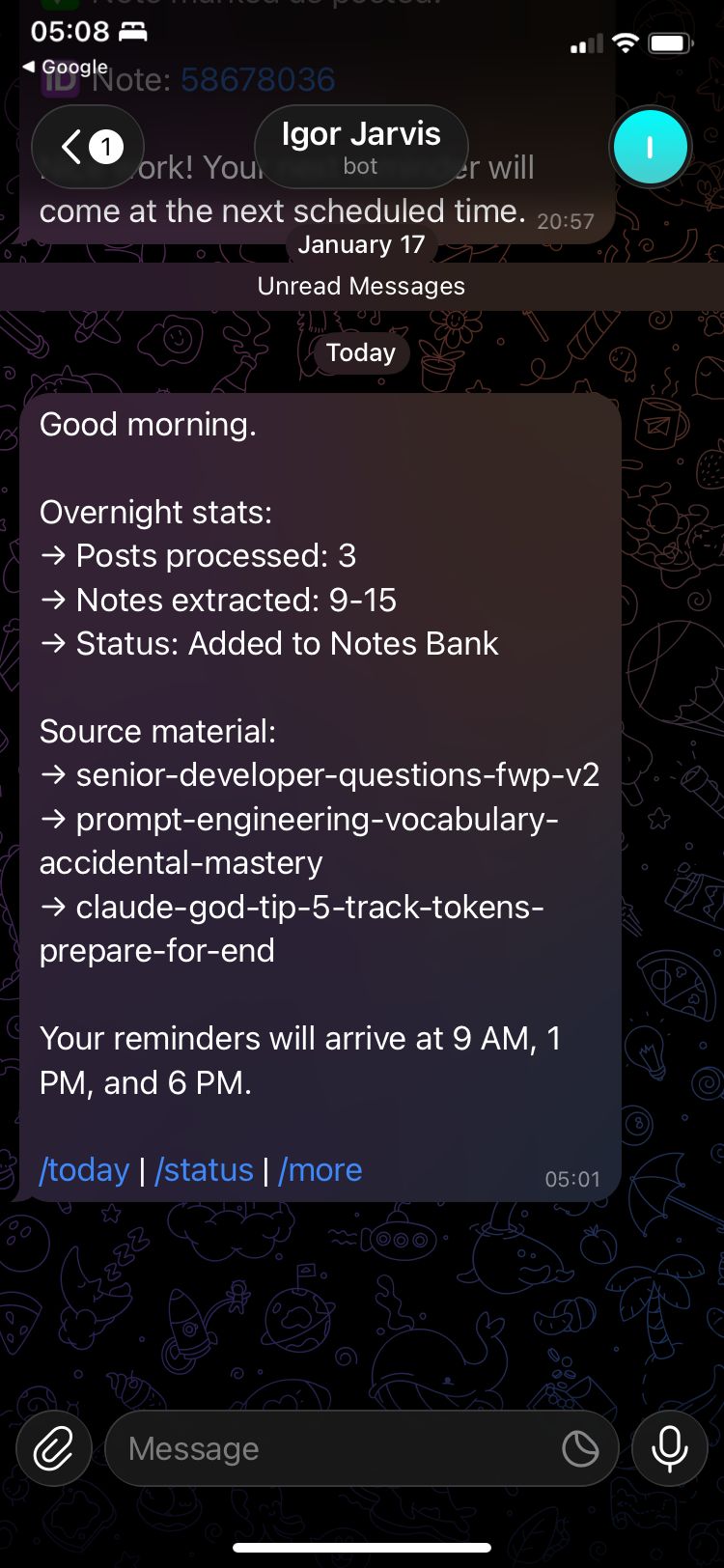
These are just 2 of the 10 different message templates Igor uses for his morning extractions. Some days he is blunt ("Done. 3 posts. 9-15 notes. All banked."). Other days he is a bit more... Igor ("While you were dreaming, I was extracting.").
This extraction happens automatically every 3 days. Not daily, because daily would build an overwhelming backlog of notes. The 3-day rhythm keeps the Notes Bank healthy, while a /more command lets me trigger extra extractions on demand whenever I want.
9 AM: The First Reminder
Three hours later, I have made my tea, done my morning routine, and settled into work. My phone buzzes.
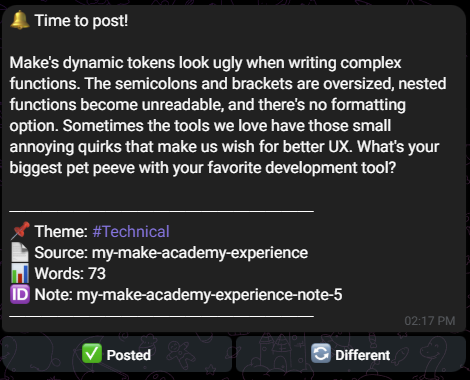
Igor has dynamically selected a note from the Notes Bank and is reminding me it is time to post. Notice those two buttons at the bottom. I do not have to type anything to respond to him. One tap and I am done.
If I like the note, I tap the green checkmark. If I do not, I tap the blue refresh button and Igor immediately sends me a replacement.
After Posting: Confirmation
Let us say I liked the note and posted it to Substack. I tap the "Posted" button.
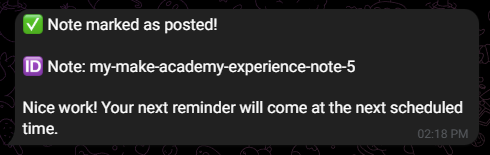
Simple and clean. The note gets marked as "posted" in the Google Sheet with a timestamp, and Igor moves on with his day.
When I Want Something Different
Now let us say it is the 1 PM reminder and the note Igor picked just does not feel right. Maybe it is too similar to what I posted that morning, or maybe I am simply not feeling that topic today.
I tap the "Different" button.
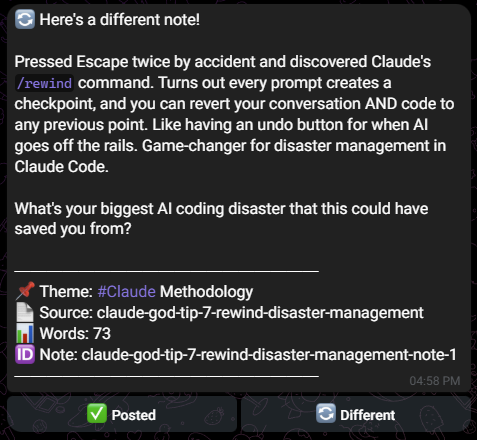
Within seconds, Igor rejects the current note (marking it as "rejected" so it never appears again) and pulls a fresh one from the available pool. Same format, new content.
6 PM: The Third Reminder
The day continues. At 6 PM, another reminder arrives. Same flow, same options. Post it or swap it.
By the end of Monday, I have posted 3 Substack Notes without writing a single word. All I did was tap buttons and copy-paste content that Igor prepared days ago from blog posts I wrote months ago.
Tuesday Through Friday: Talking to Igor Directly
The automated reminders are just the foundation. The real power shows up when I need to interact with him on demand.
On Wednesday, I get curious about how many notes are left in the bank, so I type /schedule.
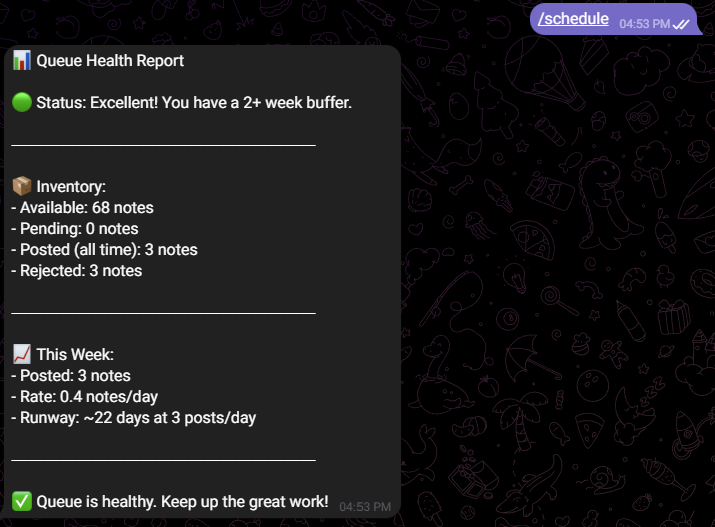
A queue health report. Available notes, posted count, and a runway calculation that tells me exactly where I stand without opening a single spreadsheet.
On Thursday, I want to see which themes I have the most content for, so I type /themes.
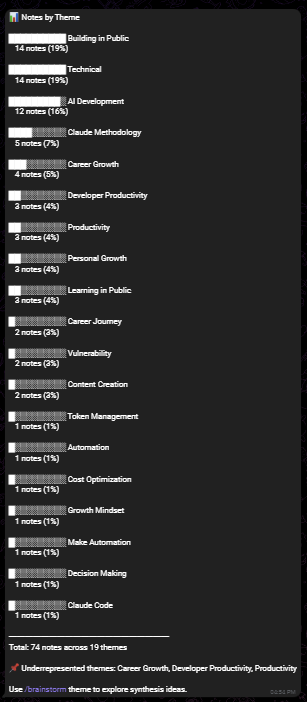
A breakdown by theme. Now I know if I am overweighted on "Claude Methodology" and underweighted on "French Learning," which helps me plan which blog posts to write next.
By Friday, maybe I have forgotten a command, or maybe someone new is reading over my shoulder and wants to know what Igor can do. I type /help.
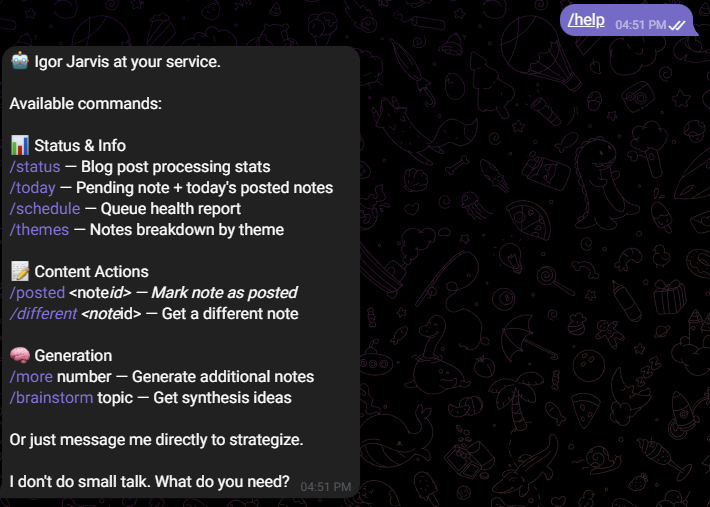
Everything laid out. Status checks, content actions, and that final line: "I don't do small talk. What do you need?" Pure Igor.
Speaking of status, here is what /status looks like:
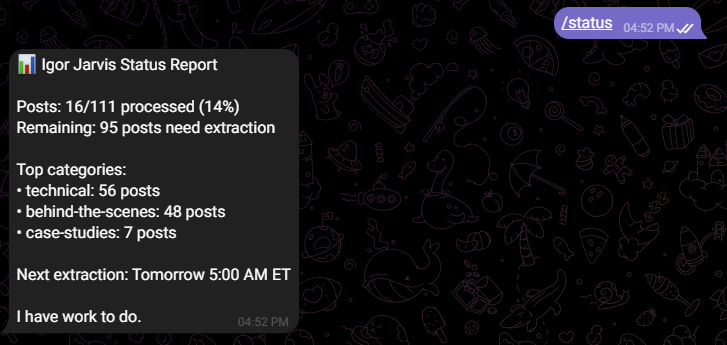
Posts processed, notes generated, top themes, next extraction. Everything I need at a glance.
The Weekend: Generating More and Finding Connections
By Saturday, let us say I have been posting consistently and my Notes Bank is getting low. The runway from /schedule shows about 5 days of content left. I need more notes, so I type /more 1.
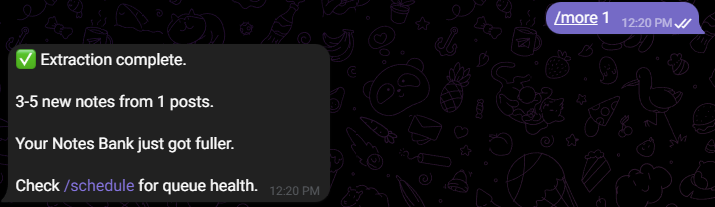
Igor calls the extraction workflow as a sub-workflow, processes 1 blog post, and adds 3 to 5 fresh notes to the bank. All on demand.
This command is exactly why I switched the automatic extraction from daily to every 3 days. I don't need Igor extracting constantly when I can simply ask for more the moment the queue gets low. If I do not specify a number, he processes 2 blog posts by default.
Then Sunday morning arrives. I am sipping tea and thinking about what long-form content to write next, so I want to find connections between my existing posts. I type /brainstorm tokens.
This command needs a topic. If I forget to include one, Igor kindly reminds me of the correct usage. Error handling at its finest.
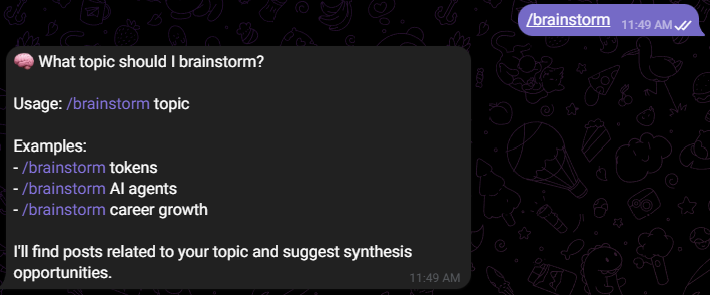
Igor searches his Pinecone vector database of 100+ blog posts, finds thematic connections, and suggests synthesis opportunities. Posts that could combine into comprehensive Substack articles. New angles I had not considered.
Here is what the brainstorm looks like with a proper topic:
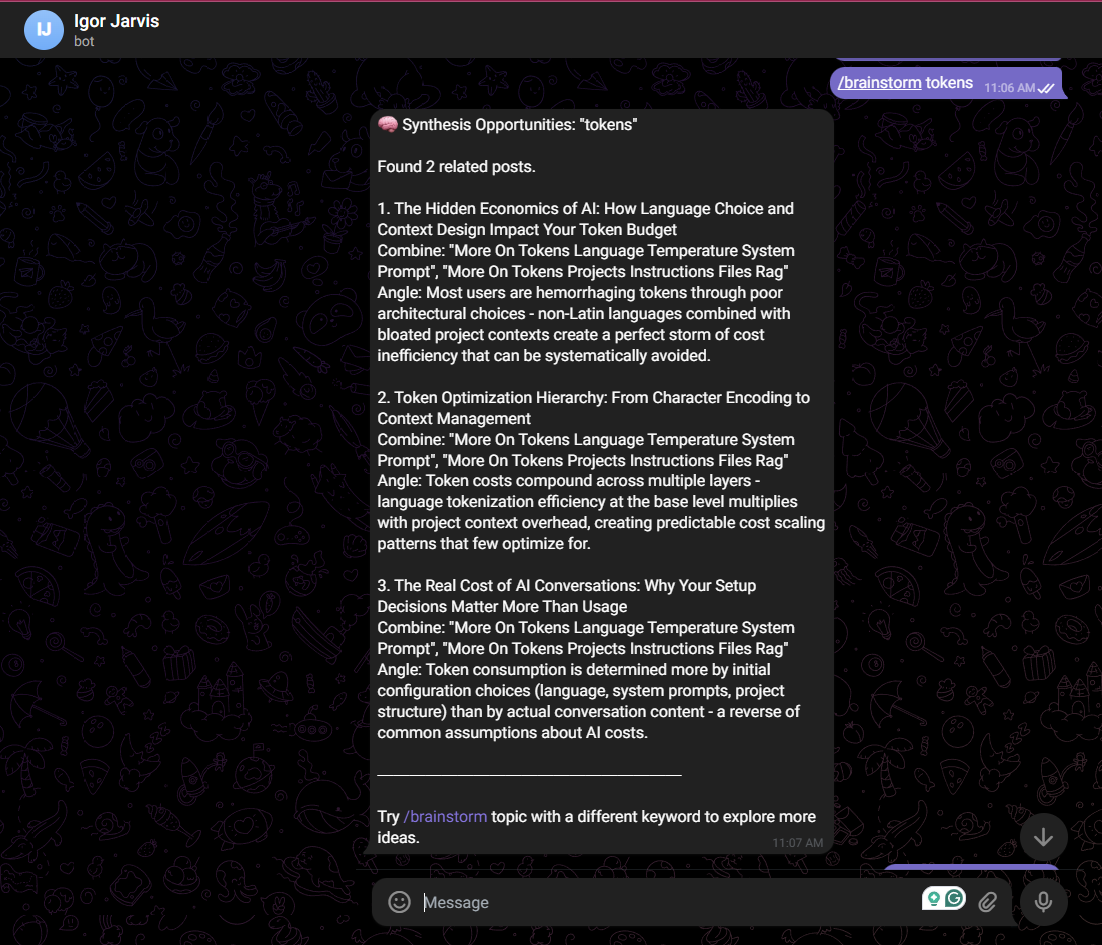
Semantic search through 100+ posts, Claude analysis, and formatted synthesis suggestions. This is where Igor's analytical nature truly shines.
The Feedback Loop
As you have seen from the story above, I can reject Igor's notes and the ones I reject get marked in a Google Sheet.
After rejecting a number of posts, I will make Igor analyze those posts to infer why I may have rejected them while also providing my own feedback on a mass scale.
This will improve him and make him suggest better posts that align with what I want.
This way, the system learns and improves over time.
What Igor Actually Bought Me (And Why I Turned Him Off)
The goal I set when I first built him was to post a minimum of 3 notes every single day without having to think much about it.
For a while, he delivered exactly that. I posted three notes a day without writing a single word, and I genuinely loved building him. I mean, learned so much in the process...
And then, last month, I turned him off.
The honest reason being that a recent reflection forced me to admit that Igor was helping me run from a simple truth: I am bad at short-form content that stands on its own, and building an elaborate autonomous system was a very me way of avoiding that instead of facing it.
Whenever I sit down to write, it almost always ends with a long form content because I can't stop stacking ideas upon ideas. My writings tend to be long streams of consciousness and I don't think that works well for substack notes.
The only place I can manage to write short form content a lot easier is when I am responding to another person's long form content, like leaving a comment.
But I do know that while I have turned him off, the underlying pattern behind this workflow will still serve many others in different use cases.
Let me show you how.
What your version of Igor could be
Strip away my specific problem and what is left is one of the most useful patterns I have ever built.
Take a large archive of long-form content you already own and mine it systematically into small, scheduled pieces.
Then deliver them to a human through a chat interface where one tap approves or rejects each one.
Once you see the pattern beyond the personality, it starts showing up everywhere:
- The case studies your team never reopens. All those case studies and won deals your team never reopens, mined into a rep's next talking point. One tap sends it.
- The help docs buried in your wiki. Help docs and old tickets buried in a wiki, mined into the agent's next reply. One tap sends it.
- The handbook questions you answer every single day. The same handbook questions answered every single day, mined into an instant answer instead of another meeting.
- The onboarding doc new hires never finish. A handbook new hires never finish, mined into one small task a day that a manager taps to approve.
- The SOPs nobody reads twice. SOPs sitting in a policy library nobody reads twice, mined into one short weekly reminder.
- Internal communications. Leadership updates too long for anyone to actually read, mined down to the lines that matter.
Now, pause and think about the repetitive, draining, oddly specific thing in your work that you have accepted as just part of the job.
Because that thing does not have to be yours to carry anymore.
You could hand it to a system, and if you are dramatic like the Prisca in my head, you could even give it a name.
Building custom AI teammates like Igor is what I do for companies and busy professionals who are tired of carrying the same repetitive work by hand. If you want your own version, something that takes one specific task off your plate and runs it for you, tell me about the task you would hand off and we can figure out what it would take to build it.
As always, thanks for reading!